What Sakana's Fugu Means for AI Ad Creative
Sakana's Fugu put multi-model AI in the headlines. What coordinating many AI models means for your ad creative, quality, and volume.
The Tadka team
TL;DR
Sakana AI's Fugu, launched June 22, 2026, is a multi-model system. It coordinates several leading AI models behind one interface instead of relying on a single model. That same idea already shapes how AI ad creative gets made. Building one strong ad takes several different skills (writing the hook, designing the image, cutting variants, and reading performance), and no single model is best at all of them. The best AI ad creative tools, including Tadka, send each job to the model that does it best, which is how you get both quality and volume from a single brief.
Sakana Fugu took over AI headlines this week, and most coverage framed it as a benchmark race: can a coordinated team of models match a single frontier model like Claude Fable 5 or GPT 5.5? For marketers, that is the wrong question. The useful part is the architecture, because it mirrors how high-volume ad creative is already produced in 2026.
If you run paid social or search, you do not need Fugu's benchmark scores. You do need to understand why coordinating several models beats betting on one, because that single choice quietly decides how much on-brand AI ad creative you can ship each week. Below you will get a plain definition of Fugu, why one model cannot carry an entire ad, how a multi-model pipeline works, and what it changes for your Meta and Google campaigns.
What Sakana Fugu and multi-model AI actually are
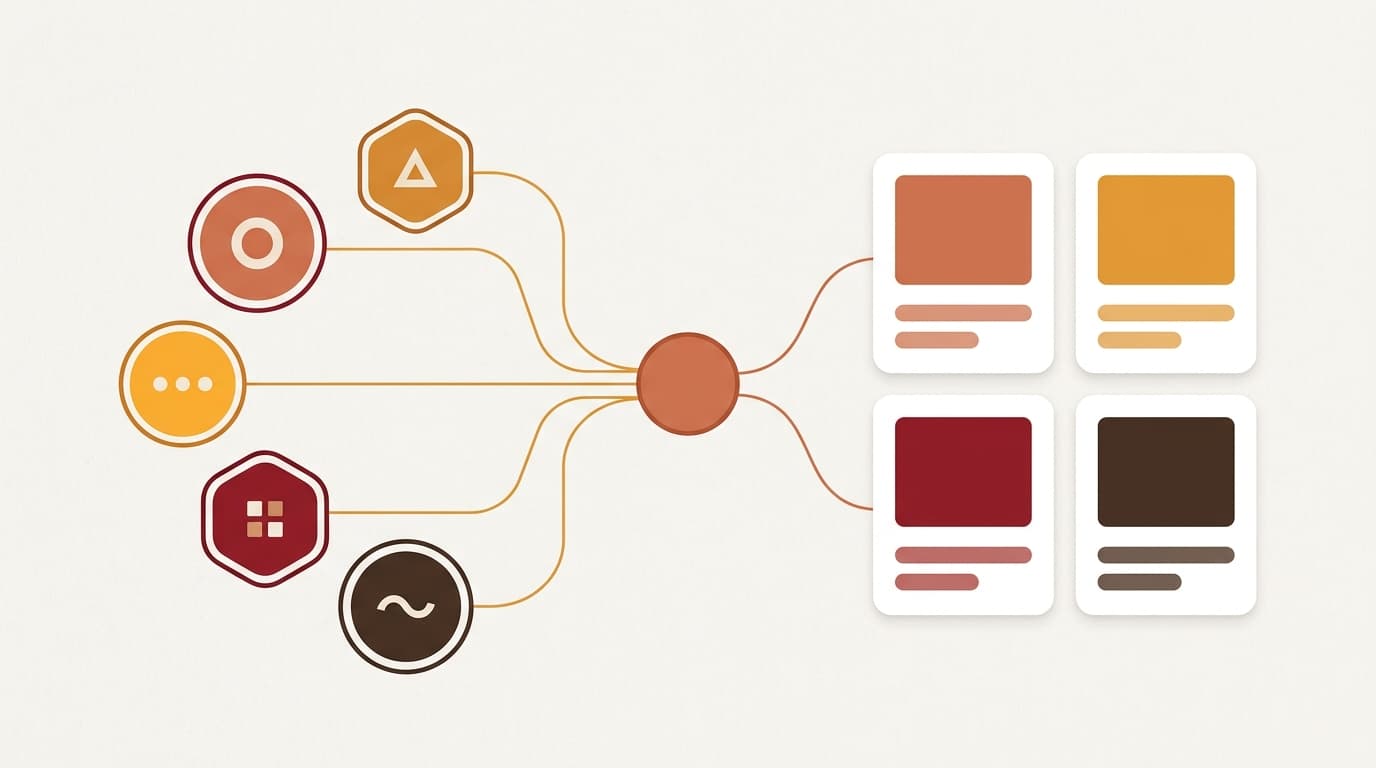
Sakana Fugu is a multi-model orchestration system. Instead of answering with one model, it works like a project manager: it reads your task, decides whether to handle it directly or break it into parts, routes each part to the model best suited for it, checks the results, and returns one combined answer. Sakana ships two tiers, Fugu and Fugu Ultra, and says Ultra rivals single frontier models without training one of its own.
Under the hood, Sakana credits two of its research efforts, Trinity and The Conductor, for choosing and coordinating the models. The selling point for engineers is not only performance but resilience, because spreading work across models reduces dependence on any single provider. For our purposes the mechanism matters more than the brand name, since the same coordinate-the-specialists logic is what makes high-volume ad creative possible.
The term that matters is multi-model, meaning many specialist models working together. Do not confuse it with multimodal, which means one model that handles several media types such as text and images at once. The two sound alike and get mixed up constantly, but Fugu is the multi-model kind: coordination across models. If your real question is whether you can plug Sakana Fugu into your own ad workflow, the companion post on using Sakana Fugu for ad creative answers that directly.
Why one model cannot make a great ad
An ad is not a single task. One static ad for Meta Advantage+ or Google Performance Max bundles several distinct jobs, and each job rewards a different model strength:
- The hook and headline need punchy, platform-native short copy.
- The visual needs faithful brand colors, layout, and an accurate product.
- The formats need correct native sizes for every placement.
- The variants need controlled variation at volume, not random drift.
- The performance read needs pattern-finding across results data.
| Job inside one ad | What it rewards | Why a single model struggles |
|---|---|---|
| Hook and headline | Short, native, on-platform copy | Models tuned for reasoning often write generic lines |
| On-brand image | Brand colors, layout, product accuracy | A strong text model can be weak at controllable images |
| Format and resize | Correct native sizes per placement | Layout fidelity is a separate skill from generation |
| Variants for testing | Volume with controlled variation | One model at scale tends to repeat itself |
| Reading performance | Finding patterns across results | Generating creative and analyzing it are different strengths |
No single model tops every column. That is the same reason Sakana built Fugu as a coordinated team instead of one larger model. The lesson transfers cleanly to creative: a system that routes each step to the right engine beats any one model trying to do all five jobs at once, especially when you push it for volume.
This is not a knock on any single model. Frontier models are remarkable at what they do. The issue is that an ad is a bundle of unlike tasks, and tuning one model to be great at short native copy, controllable brand imagery, precise layout, and large-batch consistency all at once is a harder problem than being great at any one of them. Coordination sidesteps that by letting each model play to its strength.
How multi-model AI ad creative works
A multi-model creative pipeline parses your brief once, then hands each stage to a different strength. This is how a tool like Tadka turns one brief into hundreds of ad creatives: language models draft platform-native hooks, image generation renders on-brand visuals, a layout step fits each native placement, and a performance layer learns which combinations win. You provide one input and receive a grid of audience-tuned variants, without wiring five separate tools together yourself.
The orchestration is the quiet advantage. Because each model does only what it is best at, the output holds up across copy, design, and format at the same time, which is exactly what a single general-purpose model tends to drop the moment you ask it for fifty variations instead of one.
A quick example: one brief, many models
Say you feed in one brief for a running shoe. A multi-model pipeline can produce a speed-focused hook for competitive runners, a comfort angle for first-time buyers, and a price-led message for deal seekers, each rendered on brand and sized for TikTok, Meta, and Google. One input becomes dozens of distinct, testable creatives. A single general model can draft those three angles as text, but it will not reliably render, size, and vary them as finished ads, which is the gap a coordinated system closes.
The same logic scales down. Even if you run only one platform, a coordinated approach lets you test more angles per week than a single tool comfortably produces, and more tested angles is usually where the next performance gain hides. Volume is not the goal in itself, but it is the input that lets the platform find your winners faster.
Multi-model vs multimodal: a quick disambiguation
| Term | What it means | Example |
|---|---|---|
| Multi-model | Many models coordinated, each used for its strength | Sakana Fugu, or an ad tool routing copy and image to different engines |
| Multimodal | One model that understands or generates several media types | A model that reads a product photo and writes matching ad copy |
Both matter for ad creative. Multimodal lets one model connect your product image to its copy, while multi-model lets a system pick the best engine for each step. Modern ad platforms lean on both, which is why the strongest output comes from coordinated systems rather than any single model.
What this means for your campaigns
Meta Advantage+ and Google Performance Max now automate targeting and bidding, so creative is the main lever you still control. These systems learn faster when you feed them many distinct creatives per ad set, and they stall when you recycle the same few. That is the creative volume problem, and it is why creative supply, not targeting, drives most of the gains available in 2026.
A multi-model approach is what makes that volume affordable to produce. When one brief can fan out into dozens of on-brand variants, you can rotate creative often enough to delay creative fatigue and keep the algorithm fed. The constraint stops being how fast a designer can work and becomes how clearly you can write the brief.
In practice that means setting a refresh cadence you can actually sustain. If your campaigns can absorb a dozen new creatives a week and your team can make four, the system is running on a fraction of the variety it wants. Closing that gap is less about a smarter model and more about a pipeline that produces on-brand variety at the rate your media buying consumes it.
What still needs a human
Multi-model systems remove the manual production grind, not your judgment. You still write the brief, set the brand rules, and decide which winning creatives to scale. Put plainly: AI ad creative compresses the time from idea to a hundred testable ads, and you keep the strategy. Sakana Fugu makes the same trade in its own domain: it automates which model handles what, but a person still defines the task and checks the result.
When a multi-model approach is worth it
None of this means more models is always better. The win comes from matching each task to the right engine, not from piling on complexity for its own sake. A few rules of thumb keep the decision simple:
- Use a multi-model AI ad tool when you need many on-brand variants per week across more than one platform.
- Use a single general model when you are drafting one-off copy or exploring concepts, not producing campaign-ready creative at volume.
- Prioritize tools that learn from performance, not only ones that generate, once you are running continuous tests.
- Judge the system, not the model, by looking at the finished ad across copy, image, and format together.
Takeaways you can act on this week
- Count how many distinct creatives you actually ship per ad set each week, then compare it to how many Advantage+ or PMax can absorb.
- Stop rating AI ad tools by one model's quality, and start rating the system's output across copy, image, and variants.
- Map each stage of your creative process to the strongest tool for it, or use a platform like Tadka that handles the routing for you.
- Launch one small variant test now and let performance pick the winner instead of guessing.
Sources: Sakana AI: Fugu release, VentureBeat: Sakana achieves frontier performance with Fugu, Nikkei Asia: Japan's Sakana Fugu multiagent AI
Sakana Fugu is a reminder that coordinating many models beats betting on one, and the same is true for your ads. Tadka turns a single brief into a grid of on-brand, audience-tuned ad creatives across every placement your campaigns need, then learns which ones win. See how it works in the studio.
Frequently asked questions
- What is Sakana Fugu?
- Sakana Fugu is a multi-model orchestration system from the Tokyo lab Sakana AI, launched on June 22, 2026. Instead of using one model, it coordinates several leading models behind a single interface and combines their work into one answer. Sakana offers two tiers, Fugu and Fugu Ultra, and positions Ultra against single frontier models.
- What is multi-model AI?
- Multi-model AI uses several specialist models together, routing each task to whichever model handles it best. It behaves more like a team than a single expert. In ad creative, that means one model can draft copy while another renders the image, so the finished ad is stronger across the board.
- Is multi-model the same as multimodal AI?
- No. Multi-model means many models coordinated together, while multimodal means one model that handles several media types such as text and images. They sound similar and get confused often. For ad creative, multi-model decides which engine does each step, and multimodal lets a single model link a product image to its copy.
- Does Sakana Fugu make ad creative?
- Not directly. Fugu is a general orchestration system, not an ad tool. Its value here is the principle it popularized: coordinating many models beats relying on one. Purpose-built tools like Tadka apply that same idea specifically to producing ad creative.
- Why can't a single AI model make a whole ad?
- One ad bundles several different jobs: short copy, an on-brand image, correct formats, many variants, and a performance read. No single model is best at all of them at once. A system that routes each job to the strongest model produces more usable creative than one model stretched across every task.
- How does multi-model AI improve ad creative volume?
- By splitting the work, a multi-model pipeline can generate many on-brand variants from one brief without a designer building each by hand. That lets you produce dozens of creatives in the time it used to take to make a few. Higher volume keeps automated campaigns supplied and slows creative fatigue.
- What is the creative volume problem?
- The creative volume problem is when automated platforms like Advantage+ and Performance Max can test more creative than your team can produce. Targeting is automated, so creative is the main lever, and a shortage of fresh variants caps performance. Tools that generate volume from one brief exist to close that gap.
- Is more ad creative actually better for Advantage+?
- Generally yes, within reason. Advantage+ campaigns learn from variety and tend to fatigue when fed the same few creatives repeatedly. Many advertisers refresh several distinct variants per ad set to keep the system learning. The goal is enough on-brand variety to avoid stagnation, not random volume for its own sake.
- How many ad creatives should I test?
- There is no single number, but most teams running Advantage+ or PMax benefit from several distinct creatives per ad set plus a regular refresh cadence. Start with what your budget can serve impressions to, then scale variety as you find winners. The practical limit is usually production capacity, which is what AI ad creative tools remove.
- Can AI ad creative stay on-brand at volume?
- Yes, when the tool enforces brand rules like palette, fonts, and layout rather than generating freely. The risk with volume is drift away from brand, so on-brand controls matter more than raw output. Platforms like Tadka are built to hold brand consistency across hundreds of variants from one brief.
- Multi-model or multimodal, which matters more for ads?
- Both contribute, and you rarely choose between them. Multimodal lets a single model connect your image and copy, while multi-model coordinates the best engine for each production step. A capable ad creative platform uses both at once, which is why output quality holds across copy and design.
- Is AI ad creative worth it in 2026?
- For teams running paid social or search at volume, usually yes, because creative is now the main performance lever and production is the bottleneck. AI ad creative shifts the constraint from how fast a designer works to how clearly you write the brief. The honest caveat is that strategy, brand rules, and final selection still need a human.
Try it on your own brand.
Describe your product and watch it become a grid of audience-tuned ads in minutes.
Start free with 5 creativesMore blog
7 Best AI Ad Tools Under $50/Month in 2026 (Honest Picks)
Comparing the best AI ad creative tools that cost under $50 per month in 2026, with honest pros, cons, and a clear decision framework.
Read →Blog · 9 min readFast Ad Creative Brief: Replace the Weekly Scramble in 2026
Learn how a fast ad creative brief cuts production time from days to minutes and keeps your campaigns fed with fresh creative.
Read →Blog · 10 min readGPT-6 Astra for Ad Creative: What It Runs, What It Costs, and What It Still Cannot Make
GPT-6 Astra can browse, click, and run multi-step ad ops on its own. Here is what it changes for ad creative, what a run costs, and where it stops.
Read →