Claude Fable 5 Is Back: What It Means for Ad Creative in 2026
Claude Fable 5 is back online. See what a frontier reasoning model changes for ad creative, and what it still cannot do for you.
The Tadka team
TL;DR
Claude Fable 5, Anthropic's most capable model, returned to global availability on July 1, 2026 after the US lifted export controls that had forced it offline. For ad creative, treat it as a reasoning engine, not an image or video generator: it can draft hundreds of ad angles, hooks, and scripts and analyze what is converting, but it does not produce the platform-ready visual variants that Meta Advantage+ and Google Performance Max run on. The bigger win is pairing a frontier reasoning model for strategy with a purpose-built production tool like Tadka for creative volume.
The story around Claude Fable 5 has been hard to miss. It launched on June 9, 2026, went offline three days later under US export controls, and came back globally on July 1 after the Commerce Department reversed the decision. If you buy media for a living, the policy drama is not the headline. The headline is that the most capable reasoning model on the market is now something you can put to work this week.
This is a practical read for performance marketers, not a benchmark recap. You will get a clear line between what a frontier model like Fable 5 does well for ad creative, what it cannot do at all, and a workflow that uses it without burning budget on the wrong tasks.

What Is Claude Fable 5?
Claude Fable 5 is Anthropic's flagship large language model, described by the company as a "Mythos-class" model that sits above its Opus tier in raw capability. It first launched on June 9, 2026, was restricted by US export controls days later, and was redeployed globally on July 1, 2026 with an added cybersecurity classifier. It runs with a 1 million token context window, up to 128,000 tokens of output per response, and step-by-step reasoning switched on by default.
| Attribute | Claude Fable 5 |
|---|---|
| Tier | Mythos-class (above Opus) |
| Launched | June 9, 2026 |
| Restored globally | July 1, 2026 |
| Context window | 1 million tokens |
| Max output | 128,000 tokens |
| Pricing | 10 dollars in, 50 dollars out per million tokens |
| Makes images or video | No |
| Best for ad creative | Angles, hooks, scripts, analysis |
For advertisers, a few facts matter more than the leaderboard:
- Anthropic reports state-of-the-art results on software engineering, knowledge work, vision, and scientific research.
- The model's lead grows as tasks get longer and more complex, which favors multi-step creative and analysis work.
- Pricing is 10 dollars per million input tokens and 50 dollars per million output tokens.
- Safety classifiers decline a small share of requests (Anthropic says under 5% of sessions on average) and route them to Claude Opus 4.8 instead.
One detail outweighs every benchmark if your job is creative: Fable 5 works in text and reasoning. It reads, writes, plans, and analyzes. It does not render images and it does not generate video. That single fact shapes how it fits into an ad-creative workflow.
Why This Release Matters Beyond the Headlines
The back-and-forth over Claude Fable 5 is a signal, not just a news story. Anthropic paused its most powerful model over safety and national-security concerns, then brought it back within weeks with tighter classifiers. For marketers, the takeaway is simple: frontier reasoning capability is going to keep climbing and keep shipping.
That matters because it moves the bottleneck. When the thinking layer gets this good and this affordable, the constraint on ad performance is no longer ideas or copy. It is how fast you can turn ideas into enough on-brand creative to feed the platforms. The teams who win the next year are the ones who pair rising model intelligence with a production process that keeps up.
The Two Halves of Ad Creative, and Which One Fable 5 Touches
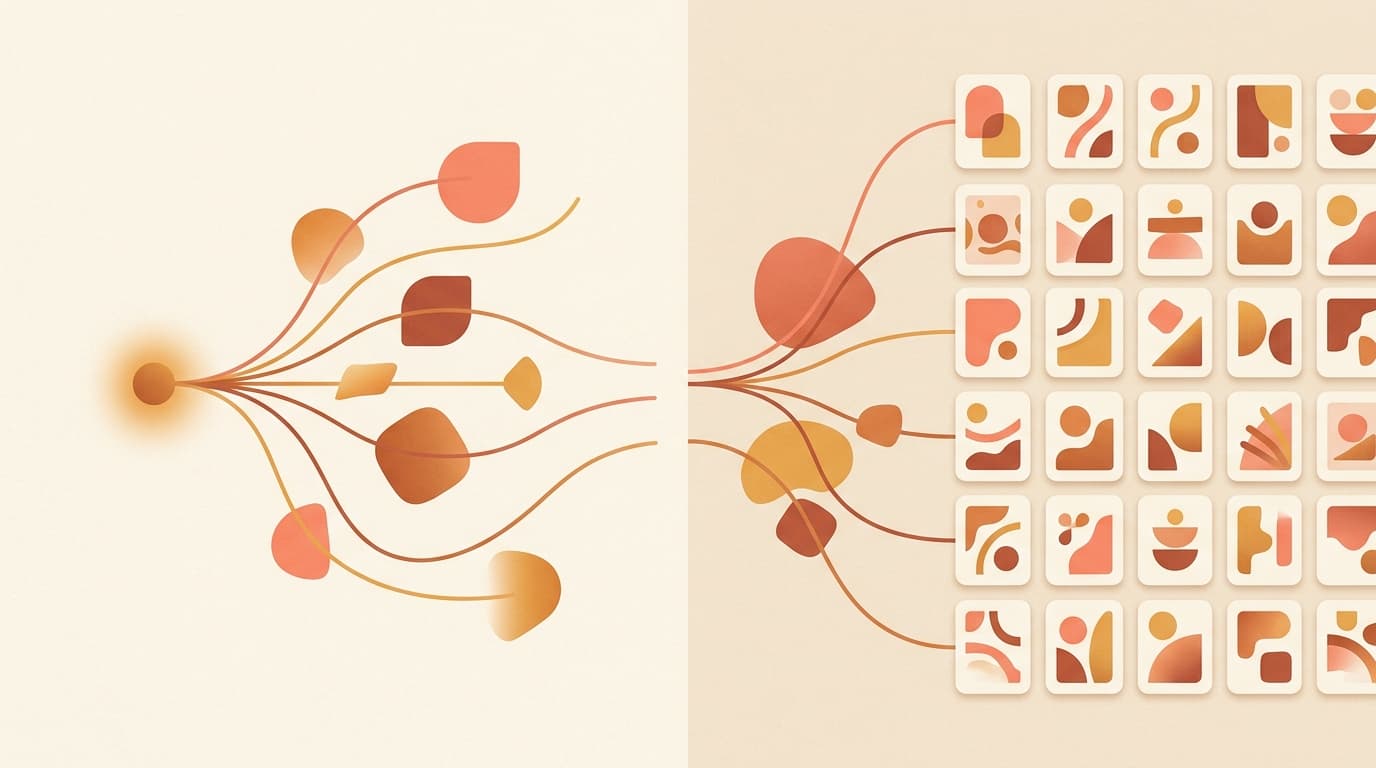
Every ad-creative program splits into two jobs. The thinking half decides what to say: the angles, the hooks, the offers, the scripts, and the read on what is working. The production half turns those decisions into finished assets: dozens or hundreds of on-brand images and videos, sized for each placement and audience. Frontier reasoning models like Fable 5 are built for the first job. They do nothing for the second.
| Creative job | Reasoning model (Fable 5) | Production tool (Tadka) |
|---|---|---|
| Generating ad angles and messaging | Strong | Consumes them as input |
| Writing hooks, headlines, and scripts | Strong | Renders them into layouts |
| Synthesizing audience and review research | Strong | Uses it to tune variants |
| Reading performance data for patterns | Strong | Feeds the next creative round |
| Producing 100+ on-brand visual variants | Not capable | Core function |
| Sizing assets for every placement | Not capable | Automatic |
| Keeping brand consistency at volume | Limited | Built for it |
What Claude Fable 5 Is Genuinely Good At for Advertisers
Used on the thinking half, a frontier reasoning model earns its keep. The strongest uses:
- Angle generation at scale. Give it your product, audience, and objections, and it will draft dozens of distinct messaging angles, not ten rewordings of one.
- Hooks, headlines, and scripts. It writes first-three-second hooks, UGC-style scripts, and headline sets you can hand straight to production.
- Research synthesis. Point it at reviews, support tickets, and competitor ads, and it clusters the language your buyers use.
- Performance analysis. With a 1 million token context window, it can read a full export of ad results and name the patterns worth doubling down on.
- Agentic testing loops. Because its lead grows on longer tasks, it can run as an agent that proposes a test, reads the outcome, and proposes the next round.
The throughline: Fable 5 is a strategist and a copywriter, not a designer.
What Fable 5 Cannot Do for Your Creative
The limits are just as important to plan around:
- It does not make the visuals. No images, no video, no thumbnails. The asset your campaign serves still has to be produced somewhere else.
- It does not solve creative volume. Meta Advantage+ and Google Performance Max reward creative variety, and starving them of fresh assets is the fastest route to creative fatigue. A smarter copywriter does not change that math.
- It does not hold brand consistency at scale by itself. Text is easy to vary, but keeping colors, logos, and layout on-brand across hundreds of assets is a production problem.
- Output costs add up. At 50 dollars per million output tokens, generating enormous copy volumes is cheap per line but not free, and it still leaves the visual bottleneck untouched.
Put plainly: a better brain on the copy does not fill the creative supply gap that modern ad platforms punish you for.
A Workflow: Frontier Reasoning Plus Purpose-Built Production
The teams getting value are not choosing between a reasoning model and a creative engine. They are chaining them.
- Brief once. Write a single tight brief: product, audience, offer, brand rules, and the objection you want to overcome.
- Reason with Fable 5. Use it to expand that brief into 20 to 40 angles, each with a hook and a one-line rationale, then rank them by fit.
- Produce at volume. Feed the winning angles into a creative-production tool like Tadka, which turns them into a grid of audience-tuned image and video variants in minutes.
- Ship to the platform. Push the variants into your Meta Advantage+ campaigns or Performance Max asset groups and let the algorithm find the winners.
- Read and repeat. Export the results, hand them back to Fable 5 for pattern analysis, and start the next round with sharper angles.
This loop keeps the reasoning model on strategy and copy, and keeps a production tool on the volume the platforms demand.
When to Use a Reasoning Model vs a Creative Engine
A simple rule of thumb:
- Use Claude Fable 5 when the task is thinking: brainstorming angles, writing scripts, synthesizing research, or analyzing what converted.
- Use a creative-production tool when the task is output: generating many on-brand variants, sizing for placements, or refreshing tired assets to beat fatigue.
- Use both, in order, when you want strategy and volume in the same workflow, which is nearly always the case in performance marketing.
The mistake is expecting either one to do the other's job. A frontier model will not render your ad, and a creative engine is not where you develop positioning.
Takeaways You Can Act On Today
- Try Fable 5 (or Opus 4.8, which handles the fallback traffic) on one real brief and ask for 30 angles, not 3.
- Keep the model on copy and strategy, and route visual production to one of the best AI ad creative tools built for creative volume.
- Measure hook rate on the variants you ship, then feed those numbers back into the model for the next round.
- Do not let a model release change your budget split. The platform still wants creative variety, not clever text.
- Build the loop once so every new campaign starts from a brief, not a blank page.
Sources: Anthropic: Claude Fable 5 and Claude Mythos 5, CNBC: Trump admin lifts export controls on Claude Fable 5 and Mythos 5, TechCrunch: Anthropic released Claude Fable 5, its most powerful model
The frontier model gives you sharper angles. Tadka turns those angles into a grid of on-brand, audience-tuned ad creatives across every style your campaigns need, so the platform never runs short on variety. See how it works in the studio, or set up the loop with the volume playbook.
Frequently asked questions
- What is Claude Fable 5?
- Claude Fable 5 is Anthropic's most capable widely released large language model, positioned above its Opus tier. It launched on June 9, 2026, and returned to global availability on July 1, 2026 after US export controls were lifted. It is a text and reasoning model with a 1 million token context window, not an image or video generator.
- Is Claude Fable 5 available again?
- Yes. Claude Fable 5 returned globally on July 1, 2026 after the US Commerce Department lifted the export controls that had taken it offline on June 12. Anthropic redeployed it with an added cybersecurity classifier.
- Is Claude Fable 5 available in India?
- Yes. As of July 1, 2026, Claude Fable 5 is available to users globally, including India, after the US lifted the export controls that had restricted access. Availability spans Claude.ai, the Claude Platform, and Claude Code.
- Can Claude Fable 5 generate ad images or video?
- No. Claude Fable 5 works in text and reasoning only, so it cannot render images or produce video. For ad creative it handles angles, hooks, scripts, and analysis, while a purpose-built tool like Tadka produces the visual variants your campaigns run.
- How much does Claude Fable 5 cost?
- Claude Fable 5 is priced at 10 dollars per million input tokens and 50 dollars per million output tokens. That makes copy and analysis work inexpensive per task, though it does nothing to address the cost or effort of producing visual creative.
- Does Claude Fable 5 have usage limits?
- Yes. When Fable 5 relaunched, Anthropic capped it at up to 50% of a subscriber's weekly usage through July 7, 2026, after which access continues via usage credits. On the API, output is capped at 128,000 tokens per response. For high-volume creative work, use the model for angles and analysis rather than trying to generate every asset through it.
- Why was Claude Fable 5 taken offline?
- The US government applied export controls to Claude Fable 5 on June 12, 2026, days after its launch, restricting access. The Commerce Department reversed the decision on June 30, and Anthropic redeployed the model globally on July 1.
- Is Fable 5 better than Opus for ad copy?
- Fable 5 leads Anthropic's Opus models on most benchmarks, and its advantage grows on longer, more complex tasks. For short, simple copy jobs the difference may be modest, so many teams reserve Fable 5 for multi-step angle generation and performance analysis.
- Claude Fable 5 vs GPT-5.6 for ad creative: which should I use?
- For the thinking half of ad creative, both frontier text models are strong at generating angles, hooks, and scripts, so choose by cost, workflow fit, and which model your stack already supports. Neither renders images or video, so both still need a creative-production step to reach ad-ready volume. Test each on one real brief before standardizing.
- Can Claude Fable 5 write Meta ad copy?
- Yes. Claude Fable 5 can draft Meta ad headlines, primary text, hooks, and scripts from a single brief. To turn that copy into the many on-brand visual variants Advantage+ rewards, pair it with a creative-production tool.
- Does a more capable AI model fix the creative volume problem?
- No. Meta Advantage+ and Google Performance Max reward a steady supply of varied creative, and a smarter language model still does not render the images or videos those platforms serve. Solving creative volume requires a production tool built to generate many on-brand assets quickly.
- What is the difference between a reasoning model and an ad-creative tool?
- A reasoning model like Claude Fable 5 decides what to say: angles, hooks, scripts, and analysis. An ad-creative tool like Tadka decides how it looks at scale: hundreds of sized, on-brand image and video variants. You get the best results by chaining the two.
- How many creative variants do Advantage+ campaigns need?
- There is no fixed number, but Advantage+ and Performance Max both perform better with a steady flow of fresh, varied creative rather than a handful of static assets. Refreshing regularly is the main defense against creative fatigue, which is why creative volume has become a core performance lever.
- Should I use Claude Fable 5 or ChatGPT for ad creative?
- Both are strong on the thinking half of creative, so choose by workflow fit, cost, and the models already in your stack. Whichever you pick, neither produces the visual assets your campaigns serve, so you still need a creative-production step.
- What does Mythos-class mean for Claude Fable 5?
- Mythos-class is Anthropic's label for models that sit above the Opus tier in capability. Claude Fable 5 is the version of that Mythos-class technology Anthropic made available for general use, with conservative safety classifiers that route a small share of sessions to Claude Opus 4.8.
Try it on your own brand
Describe your product and watch it become a grid of audience-tuned ads in minutes.
See how Tadka worksMore blog
7 Best AI Tools for Creative Testing in 2026
Compare the top AI tools for high-volume creative testing in 2026, from image generators to UGC-style ad platforms, with honest pros and cons.
7 Best AI Ad Creative Tools for Agencies in 2026
Comparing the top AI ad creative tools for agencies in 2026, ranked by creative volume, brand control, and multi-client workflow.
Creative Testing for Paid Ads: A 2026 Playbook
Learn how creative testing works for Meta, Google, and TikTok ads, including frameworks, metrics, and how to scale winning concepts in 2026.